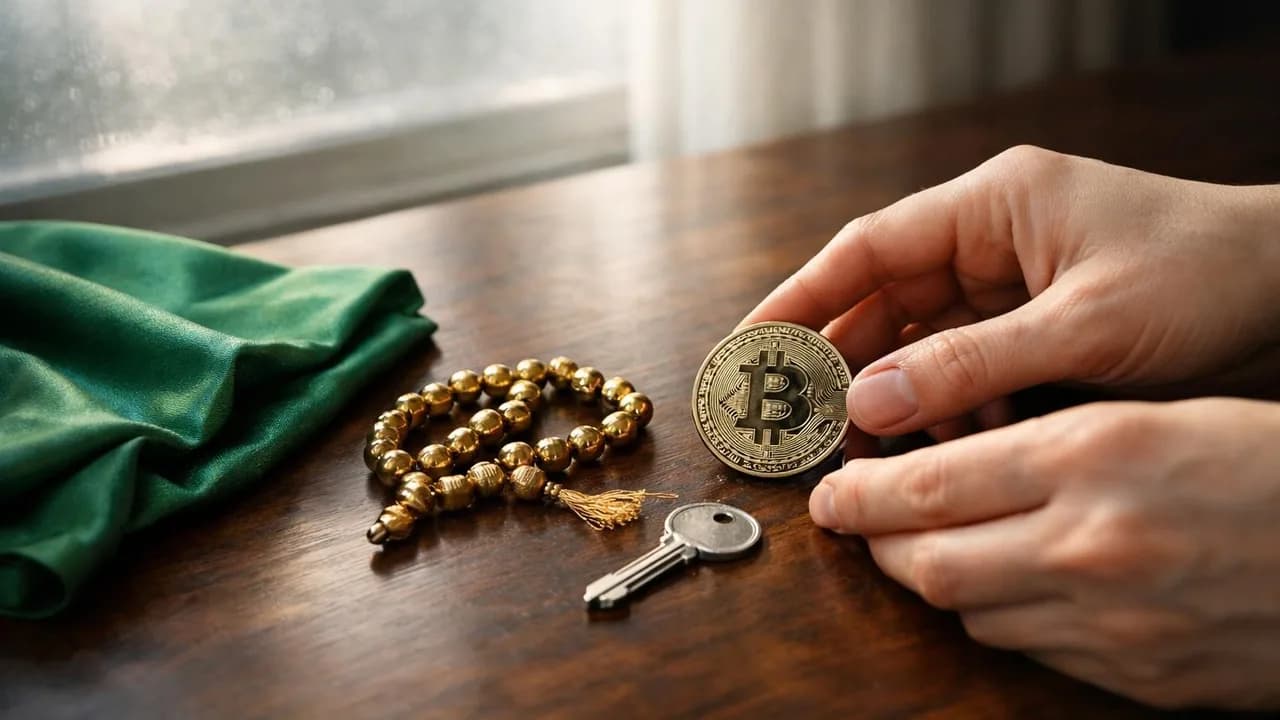
Bitcoin is halal according to a permissive camp of Shariah advisers, including Amanah Advisors' Mufti Faraz Adam, who treats crypto-assets with lawful utility as property (māl) that may be bought and held; it is prohibited according to a stricter camp of traditional darul iftas, including Darul Uloom Karachi, which issued a fatwa in June 2026 prohibiting the stablecoin USDT and is reviewing digital assets more broadly. All camps agree that staking yield on lent coins, crypto lending and margin or futures trading are impermissible. For a UK holder the practical layer is the FCA's financial promotions regime, HMRC capital gains tax with a £3,000 annual exempt amount, and zakat on the holding. This page supports the is crypto halal hub with the Bitcoin-specific detail.
Ready to compare halal options?
Where scholars stand on Bitcoin in 2026: three camps
The disagreement is about what Bitcoin is, not about riba. A permissive camp, dominated by Shariah advisers who certify fintech products, argues that a crypto-asset with a lawful use is māl (property) under classical rules, can be bought, sold and held, and can even function as a medium of exchange inside its own network by the custom of that network's users. A prohibitive camp, mostly traditional fatwa councils in South Asia, holds that Bitcoin lacks the backing, issuer accountability or stable value required of money, that its price is driven by speculation (gharar and maysir concerns), and that holding it is therefore not permissible or at least not advisable. A conditional middle treats Bitcoin as a permissible but highly risky asset for which the holder must avoid any yield, borrowing or derivative layer.
The 2026 developments come from the prohibitive side engaging with the permissive side. Amanah Advisors published a research paper on 14 July 2026 recording that in late June 2026, at the direction of Mufti Taqi Uthmani, Mufti Faraz Adam was invited to present his research on the Shariah classification of digital assets to the Darul Iftaa committee of Darul Uloom Karachi. The paper quotes Mufti Abdullah Uthmani stating that Darul Uloom Karachi's latest fatwa on USDT being prohibited was issued in early June 2026, that similar fatawa had been issued before, that the Darul Ifta is reviewing the evidence presented by scholars on different sides, and that it is in communication with the Pakistan Virtual Assets Regulatory Authority. No revised Bitcoin ruling had been published by either body when this page was checked.
What the permissive position actually says, from Amanah Advisors
Mufti Faraz Adam's published view, in a 2021 piece on amanahadvisors.com drawn from his book on Islamic fintech, is that many crypto-assets can be deemed digital assets and that having a lawful utility is sufficient to regard something as māl. He writes that crypto-assets designed as payment tokens can be considered a medium of exchange within their own ecosystem under the principle of al-urf al-khass (the custom of a specific group), but that it may be premature to consider them universal currencies. The same piece says Shariah screening before investing is essential and sets out five screens: legitimacy (is the project genuine), project (is the underlying business halal), financials (for equity-like tokens), token (what rights the token carries) and staking (how any staking mechanism works).
That framework is why Bitcoin tends to pass in the permissive camp while many altcoins fail. Bitcoin has no issuing company whose revenues need screening, no promise of yield, and a payment-token design. An exchange token that gives discounts on a platform that lists lending products, or a governance token for a protocol whose main activity is interest-bearing lending, fails the project screen regardless of how the token itself is classified. The what makes a stock halal guide explains the equivalent business-activity test for shares, which is the model the token screens borrow from.
Bitcoin, Ether, XRP and stablecoins: the ruling and the sticking point
The table summarises how each major asset fares under the permissive camp's five screens and where the prohibitive camp's objection bites. It is a reading of published positions, not a fatwa. For any coin the first question is whether you hold the asset itself in your own wallet or on a registered exchange; the second is whether anything is being done with it to generate a return.
| Asset | Permissive camp reading | Sticking point | Prohibitive camp |
|---|---|---|---|
| Bitcoin (BTC), held | Permissible as māl; payment-token design | Volatility; no issuer; speculation concern | Not permissible or not advised |
| Ether (ETH), held | Generally permissible as a utility asset | Network hosts lending and derivative protocols | Same objection as Bitcoin |
| Ether, staked for yield | Contested; depends on whether reward is a fee for validation work or a return on a loan | Liquid staking and lending-based yield widely treated as riba | Prohibited |
| XRP | Depends on the project screen | Centralised issuer and large pre-mined holding raise questions about what the token represents | Prohibited |
| Fiat stablecoins (USDT, USDC) | Permissive advisers treat as a dollar claim, usable for payment, no yield | Reserve composition; any yield on holdings | Darul Uloom Karachi: USDT prohibited (June 2026) |
| Algorithmic stablecoins | Avoided | FCA cites TerraUSD's 2022 collapse as the example | Prohibited |
Two caveats. First, Amanah's staking screen means the permissive camp does not wave staking through; a validator paid a fee for work it performs differs from a protocol paying a percentage return on tokens deposited with a third party, which looks like a loan with an increment. Second, the FCA's consumer page warns that some so-called stablecoins have no assets backing them and names TerraUSD, whose value collapsed in 2022 after detaching from the US dollar.
Staking yield, lending and margin trading: the clear red line
Whatever a scholar thinks of Bitcoin, the layer of products built on top of coins is where the rulings converge. Lending your coins to a platform or protocol in return for a percentage return is a loan with an increment, which is riba. Earning a yield by depositing tokens into a pool that lends them on is the same transaction with extra steps. Margin trading borrows money or coins to increase position size and usually pays a funding rate, which is interest, and perpetual futures settle a price difference without any asset changing hands, which is a bet. None of this depends on Bitcoin's own classification.
- Buying Bitcoin outright and holding it in a wallet you control is the case the permissive camp accepts and the prohibitive camp rejects; it is the only version where the disagreement is genuine.
- Lending coins to an exchange's earn product for a stated percentage is riba under every published position we found, including the permissive one.
- Staking through a third party that promises a percentage yield fails Amanah's staking screen unless the reward is shown to be a fee for validation work rather than a return on a deposit.
- Margin and perpetual futures involve borrowing at a funding rate and settling price differences without delivery; both are treated as riba and maysir.
- Day trading spot Bitcoin with your own money is not riba but is where the gharar and maysir objections of the prohibitive camp are strongest.
- HMRC treats tokens received from mining, staking or lending as income, so the tax rules independently mark out the same products.
The FCA layer: registered firms and the financial promotions rules
The FCA's consumer pages are blunt: crypto is largely unregulated in the UK, you should be prepared to lose all the money you invest, and you are highly unlikely to be covered by the Financial Services Compensation Scheme or able to use the Financial Ombudsman Service for crypto losses. Firms carrying on cryptoasset activity in the UK have had to register with the FCA for anti-money laundering supervision since 10 January 2020. From 8 October 2023, qualifying cryptoassets came within the FCA's financial promotions remit under PS23/6, which applies to any firm marketing crypto to UK consumers regardless of where it is based. On 30 June 2026 the FCA published final rules and guidance that will apply to cryptoasset firms granted permission under the Financial Services and Markets Act on or after 25 October 2027.
For a Muslim holder the promotions regime is a useful filter. Compliant marketing must carry prominent risk warnings, and the FCA says you should not be offered free gifts to join or refer-a-friend bonuses; if you see an incentive and no warning, the firm is not following the rules and may be illegal or a scam. Check the firm on the Financial Services Register before depositing. The FCA's own illustration of volatility is instructive: it records Bitcoin's peak at £93,947 on 6 October 2025, falling 30.44% to £65,350 by 1 December 2025, so £300 invested at the peak was worth £208.68 two months later. That is the risk the prohibitive camp has in mind. The halal investing guide covers how a crypto sleeve, if you hold one, sits against regulated investments on the investing hub.
HMRC: capital gains, pooling and the £3,000 annual exempt amount
HMRC treats cryptoassets as assets for Capital Gains Tax. You may owe CGT when you dispose of tokens by selling them for money, exchanging one token for another, using them to pay for goods or services, or giving them away other than to a spouse or civil partner. Gains are worked out using pooling: each type of token forms a pool with an average cost, so if you buy 100 tokens at £2 and later 300 at £1, your 400 tokens have a pooled cost of £500 or £1.25 each, and selling 200 uses £250 of cost. The annual exempt amount is £3,000 for individuals in 2026 to 2027, so a £10,000 gain leaves £7,000 taxable. From 6 April 2026 the rate is 18% where the gain plus your taxable income sits within the £37,700 basic rate band and 24% above it; on £7,000 that is £1,260 or £1,680.
Income tax applies separately to tokens you receive rather than buy. HMRC's manual at CRYPTO21200 says that where staking does not amount to a trade, the sterling value of tokens awarded is taxable as miscellaneous income at the time of receipt, with CGT due on any later gain. The same treatment applies to mining, lending and DeFi rewards, and there is a £1,000 trading and miscellaneous income allowance that crypto income counts towards. Tokens paid by an employer are earnings subject to income tax and National Insurance. Keep records of every disposal, the number of tokens, and the pooled cost before and after, because HMRC notes that exchanges will not track your pooled cost for you.
Zakat on Bitcoin and other crypto holdings
If you hold Bitcoin on the permissive view, it is zakatable. The common treatment among advisers who accept crypto as māl is to value the holding at market price on your zakat date and include it with cash and other liquid assets, since a payment token is held as a store of value or for trade rather than for use. Coins you have ruled out on Shariah grounds but still hold should be disposed of and the proceeds purified according to the scholarly guidance you follow, which is a separate question from zakat. The zakat on savings, pensions and investments guide sets out the nisab, the rate and the valuation date mechanics, and the UK zakat hub links to the National Zakat Foundation calculator.
A practical point: HMRC's disposal rules mean that converting Bitcoin to pounds to pay zakat is itself a disposal, so a holder sitting on a gain crystallises CGT when they liquidate for zakat. Paying zakat in kind, by transferring coins to a charity that accepts them, is also a disposal for CGT purposes unless the gift qualifies for a charity exemption, so check with the charity and your adviser before assuming either route is tax-free.
Our view for a UK Muslim who accepts the permissive position
If you follow the permissive camp, hold Bitcoin only in the form every camp agrees is at least arguable: spot coins, bought with your own money, held in your own wallet or at an FCA-registered firm, with no yield, no lending, no staking through a third party and no margin. Size the position so that the FCA's warning, be prepared to lose all your money, is literally survivable; a 30% fall in two months is the regulator's own example. Keep a disposal log for HMRC from the first purchase, and set a zakat valuation date. If you follow the prohibitive camp or your family's mufti, nothing in this page changes that, and the regulated, screened routes on the halal stocks hub do the same job of long-term saving without the dispute.
If you are being offered a staking yield, an earn account or a referral bonus, treat the first two as riba and the third as a sign the firm is outside the FCA's promotion rules, and walk away regardless of which camp you sit in. Facts checked against fca.org.uk, gov.uk, amanahadvisors.com on 17 September 2026.
Frequently asked questions
Is Bitcoin halal or haram?
It is disputed. Shariah advisers such as Amanah Advisors treat crypto-assets with lawful utility as property that may be held and traded, which makes spot Bitcoin permissible on their analysis. Traditional fatwa bodies such as Darul Uloom Karachi have issued prohibitive rulings on digital assets, most recently on USDT in June 2026, and are reviewing the wider question. Every position agrees that yield, lending and margin on crypto are impermissible.
Is staking Ethereum halal?
Staking is the most contested layer. Amanah Advisors' framework includes a specific staking screen asking whether the reward is a fee for validation work or a return on tokens deposited with a third party. Yield paid by a platform for tokens you hand over looks like a loan with an increment and is widely treated as riba. HMRC separately taxes staking rewards as miscellaneous income at the sterling value when received.
Is XRP halal to invest in?
Under the permissive camp's screens XRP depends on the project and token tests: it has a centralised issuer and a large pre-mined holding, which raise questions about what the token represents and how its supply is controlled. We found no published fatwa from a UK body specifically approving XRP, and the prohibitive camp's objections to Bitcoin apply with more force to an issuer-controlled token. Treat it as unresolved.
Do I pay tax on Bitcoin in the UK?
Yes. Selling, swapping, spending or gifting Bitcoin is a disposal for Capital Gains Tax. Gains above the £3,000 annual exempt amount are taxed at 18% within the basic rate band and 24% above it for disposals from 6 April 2026, using HMRC's pooling method to calculate cost. Tokens received from staking, mining or lending are taxed as miscellaneous income when received, with a £1,000 allowance.
Are crypto exchanges regulated by the FCA?
Partly. UK cryptoasset firms must register with the FCA for anti-money laundering supervision, and since 8 October 2023 their marketing must follow the FCA's financial promotions rules, with prominent risk warnings and no refer-a-friend incentives. Most crypto activity itself is not yet regulated, so FSCS and Financial Ombudsman cover are highly unlikely. Final rules for a fuller regime were published on 30 June 2026 for permissions granted from 25 October 2027.
Compare providers in your state
See side-by-side comparisons of Shariah-compliant products, or let our matcher recommend the best options for your situation.
Do I pay zakat on Bitcoin?
If you hold it as a permissible asset, yes. Advisers who accept crypto as property treat it like cash or trade stock: value it at market price on your zakat date and include it with your other zakatable assets. Converting coins to pounds to pay zakat is a CGT disposal, as is gifting coins to a charity unless an exemption applies, so plan the payment with the tax in mind.